- CompressConvertAI PDF
- Organize
- View & Edit
- Convert from PDF
- Convert to PDF
- SignMoreScan
- Home
- ›
- ›The AI Edit Effect: Are Workers Reviewing AI-Written Docs Too Fast?
The AI Edit Effect: Are Workers Reviewing AI-Written Docs Too Fast?
As AI speeds up document workflows, many workers are skipping full reviews, raising new concerns about accuracy and accountability.
AI tools are now part of how many professionals create, edit, and finalize documents every day. As a platform designed to make document work simpler and more efficient, Smallpdf commissioned this study to understand how AI is affecting document accuracy. We surveyed 1,000 U.S. professionals to see how often they rely on AI-generated content and whether they take the time to review it carefully.
Key takeaways
Nearly 3 in 10 (29%) regular AI users don't fully review AI-written documents before sending them.
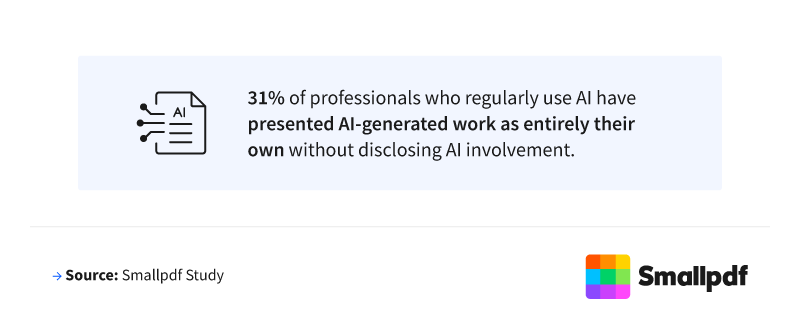
31% of regular AI users admit to presenting AI-generated work as their own.
20% of regular users say they've sent an AI-written document that later turned out to contain an error.
21% of workers feel pressured by their workplaces to produce documents faster due to AI tools.
Nearly 3 in 10 organizations have no formal policy for reviewing AI-generated documents before they go out.
The Confidence Paradox: How Much Do Workers Trust AI?
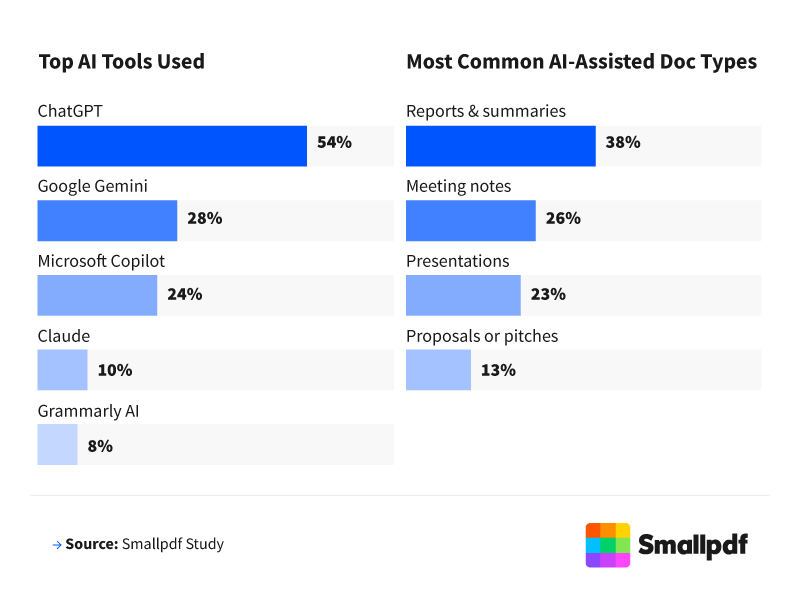
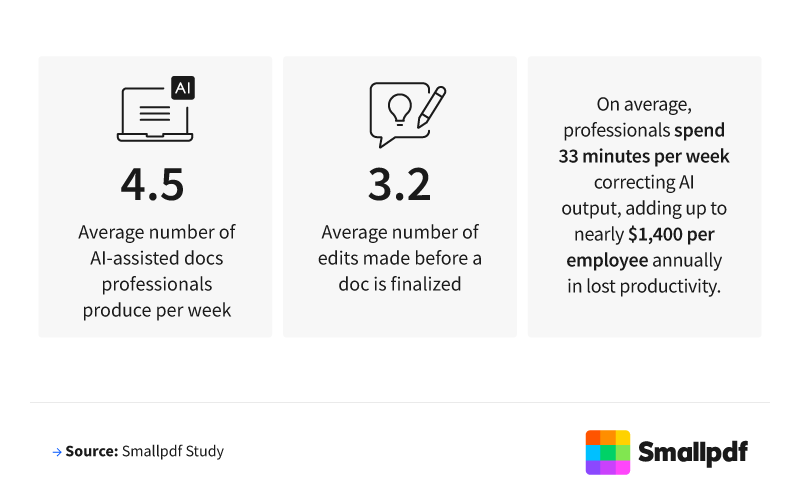
AI is now a regular part of how professionals create and manage documents. A majority of professionals (67%) said they use AI tools for work documents at least once a week, while 19% said they used them every day.
Review gaps even occurred in industries that handle high-stakes information. One in 3 finance workers and 3 in 10 tech workers admitted they did not read AI-generated documents word-for-word before sending them.
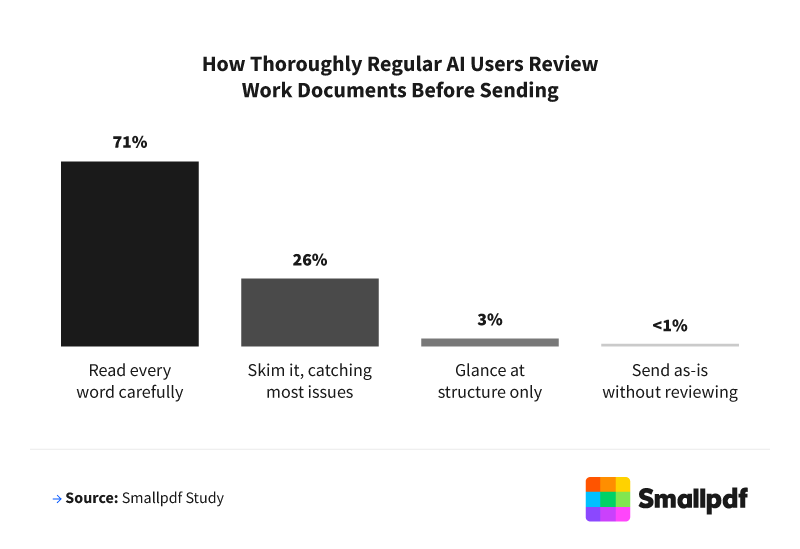
This kind of inconsistency highlights the need for simple, standardized workflows that make it easier for teams to review and finalize documents with confidence. Platforms like Smallpdf are designed to support this kind of structure. Without consistent rules, review quality often depends on personal habits instead of a shared process.
As a result, mistakes are slipping through: 20% of regular AI users sent an AI-generated document that later turned out to contain an error, with tech workers reporting this most often (22%). This reinforces the importance of having tools and processes in place to catch issues before documents are shared.
Ownership and Disclosure Are Getting Murkier
AI can help people write faster and more confidently, but it's also changing how professionals think about authorship. In many cases, workers were using AI heavily without being transparent about it.
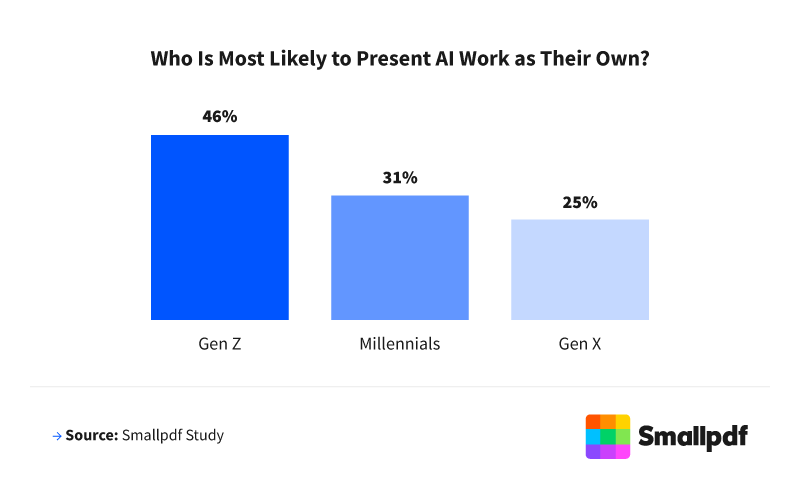
At the same time, 28% said they trust AI-written documents more than those created by junior colleagues. This points to changing expectations around skill, reliability, and experience, especially as AI becomes more embedded in everyday work.
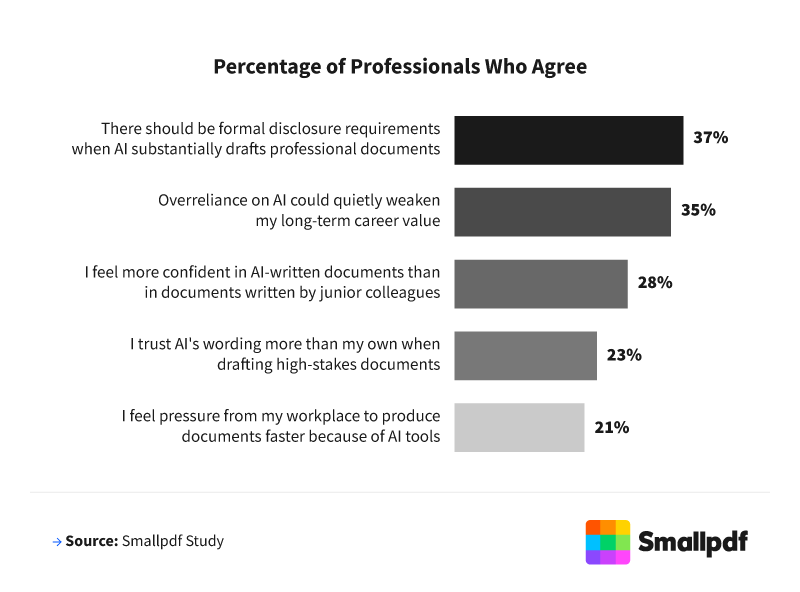
Faster Drafting Still Needs Human Judgment
AI is helping professionals move faster, but this research shows that speed alone isn't enough. Without consistent review habits and clear expectations, even small oversights can turn into larger issues, especially in high-stakes documents like contracts.
For teams and individuals, a few simple steps can make a meaningful difference:
Build in time for review. Treat AI-generated content like a first draft, not a final version.
Set clear standards. Organizations should define when and how AI-assisted work needs to be reviewed before it’s shared.
Encourage transparency. Being open about AI use helps maintain trust and accountability across teams.
Prioritize accuracy over speed. Faster output is valuable, but not at the cost of errors or missed details.
As AI becomes a standard part of document workflows, the real advantage will come from using it thoughtfully. Tools like Smallpdf can help teams streamline their workflows while still maintaining the checks and structure needed to keep documents accurate and reliable.
Methodology
This study is based on an online survey of 1,000 U.S. full-time professionals conducted in March 2026. Among the respondents, 67% were regular AI users (those who use AI tools for work documents at least a few times a month); the remaining 33% rarely or never use AI tools and were routed past AI-specific questions. Generations referenced include Gen Z (11%), millennials (60%), and Gen X (26%); baby boomers (3%) are excluded from generational comparisons due to insufficient sample size.
Industry figures are reported only for industries with at least 50 respondents and include technology/software (19%), healthcare/pharmaceuticals (14%), education (12%), finance/banking/insurance (11%), manufacturing/engineering (8%), retail/e-commerce (8%), government/public sector (7%), and other (21%). Averages for numeric responses were calculated using the IQR method to remove outliers. The estimated annual productivity cost of $1,400 per employee is based on an hourly rate of $48.50, derived from the average self-reported household income of regular AI users ($100,885 divided by 2,080 working hours per year), applied to the average 33 minutes per week spent correcting AI output across 52 weeks. All percentages are rounded to the nearest whole number.
About Smallpdf
Smallpdf helps professionals, students, and businesses work with documents more easily, from editing and converting files to compressing and eSigning PDFs. As AI becomes a bigger part of document workflows, Smallpdf gives teams practical tools to keep files polished, accurate, and easier to manage.
Fair Use Statement
This information may be used for noncommercial purposes only. If you share it, please include proper attribution and a link back to Smallpdf.
Related Articles